
Average Salaries in Moldova: What People Really Earn


In the first three months of 2026, Moldova’s official average gross salary reached 15,987 lei a month — a little under €800. To an outsider, that looks like a country closing the distance on its European neighbors. Yet walk into a bakery in Ungheni, a vineyard near Cahul, or a hotel reception desk in Chișinău, and you will meet people who have never seen a pay slip anywhere near that figure and who would be startled to hear it described as “average.”
This is the paradox at the heart of every salary statistic, and it is unusually sharp in Moldova. The average is real, officially measured, and rising. But it is also, for most workers, aspirational rather than descriptive. A relatively small cluster of high earners — in software, banking and energy — pulls the arithmetic mean upward, while the largest group of employees sits well below it. The number that makes headlines is not the number most people take home.
So what does a typical person in Moldova actually earn? Not the average worker — the typical one? To answer that, we need to go past the single figure and look at the whole shape of Moldovan pay: gross versus net, the median versus the mean, the yawning distance between a Chișinău IT office and a rural farm, and the difference between a salary that looks fine on paper and one that actually covers the rent. This article is a map of that terrain.
A note on the numbersSalary figures in this article are drawn primarily from Moldova’s National Bureau of Statistics (BNS). Unless stated otherwise, they are gross (before tax and contributions) and refer to Q1 2026, the most recent official release at the time of writing. We identify the reference period beside each figure so the analysis stays useful as data is updated. Conversions use roughly 1 EUR ≈ 20 MDL (August 2026).
What Is the Average Salary in Moldova?
Start with the official measurement. According to the BNS, the average gross monthly salary in Q1 2026 was 15,987.1 lei, about €800. That was up 9.7% in nominal terms from the same quarter a year earlier and, once inflation is stripped out, up 4.3% in real terms. For the full year 2025, the annual average came in slightly lower, at 15,472 lei, because wages tend to peak in the fourth quarter (bonuses, year-end payments) and dip in the first.
Three things about this figure matter more than the number itself.
First, it is gross, not net. The 15,987 lei is what an employer books before the state takes its share. The employee never sees that amount hit their account. (We convert it to take-home pay in the next section.)
Second, it does not cover everyone. The BNS quarterly survey measures units in the “real sector” with four or more employees, plus all public-sector institutions. It excludes micro-businesses with fewer than four staff, informal workers, most of the self-employed, and — a persistent statistical footnote — the breakaway Transnistria region. In a country where informal and small-scale work is widespread, that means the official average describes the more formal, better-documented slice of the labor market, which skews it upward relative to the population as a whole.
Third, the average is not the same as the typical. This is the crux of the whole subject, so it is worth being precise about three different words:
- The average (mean) adds every salary together and divides by the number of workers. A handful of very high salaries drags it up.
- The median is the salary of the person standing exactly in the middle: half earn more, half earn less. It ignores how extreme the top earners are, so it usually sits below the mean.
- The typical salary is what most people cluster around — and in Moldova it is meaningfully lower than the mean.
The BNS does not publish a single official median wage for the whole economy, so we should be careful not to invent one. But it does publish something almost as useful: the distribution of workers across salary bands, which shows exactly why the average misleads. We turn to that shortly. A private illustration of the gap comes from the recruitment platform Rabota.md, which analyzed more than 10,000 Chișinău job adverts in mid-2025: the average advertised salary was around 20,000 lei, but the median advert offered about 16,800 lei. Job adverts are not the same as measured earnings — they reflect what employers post, not what workers are paid — but the direction is the same one the official data shows: the middle sits below the mean.
How Much Do Moldovans Take Home After Tax?
Moldova runs one of the simpler tax systems in Europe, which makes the gross-to-net calculation refreshingly transparent. Three things come out of a standard private-sector salary on the employee’s side:
- Health insurance (CNAM): 9% of gross, deducted from the employee’s pay.
- Personal income tax: a flat 12%, applied not to the full gross but to gross minus the CNAM contribution minus a personal deduction (2,475 lei a month in 2026, for residents whose annual taxable income is below the statutory ceiling).
- Social contributions (CNAS): in the private sector these are paid by the employer (24% on top of gross), not withheld from the worker. So they raise the employer’s cost but do not reduce the employee’s headline take-home.
Put together, a private-sector employee who claims the standard personal deduction keeps roughly 80–85% of gross. Here is what that looks like across a range of salaries (an illustrative calculation using 2026 rules, not official salary data):
| Gross (MDL/mo) | Health (9%) | Income tax | Net take-home | ≈ EUR net |
|---|---|---|---|---|
| 6,300 (min. wage) | 567 | 391 | 5,342 | €267 |
| 10,000 | 900 | 795 | 8,305 | €415 |
| 15,987 (≈ avg) | 1,439 | 1,449 | 13,099 | €655 |
| 20,000 | 1,800 | 1,887 | 16,313 | €816 |
| 30,000 | 2,700 | 2,979 | 24,321 | €1,216 |
| 40,000 | 3,600 | 4,071 | 32,329 | €1,616 |
So the worker on the national average gross of about 16,000 lei actually banks something closer to 13,000 lei (≈€655) a month. Take-home varies with circumstances — whether the personal deduction is claimed at that job, whether there are dependents, and above all whether the employer is inside the IT Park regime, which we come to below. But as a rule of thumb: net pay is roughly four-fifths of the gross figure you read in the news.
The IT exceptionCompanies inside Moldova’s IT Park pay a single 7% tax on turnover that replaces income tax and both social and health contributions. Their employees typically negotiate in net terms and see almost the entire agreed sum, while the tax burden sits on the company. This is one reason IT pay looks so far ahead of everything else — the gap is even wider after tax than before it.
The Average Salary Hides a Huge Income Gap
This is the single most important section in the article, because it explains everything that follows. The BNS periodically publishes how employees are distributed across salary bands. For September 2025 (the latest such snapshot, covering full-time employees who worked the whole month), the picture looked like this:
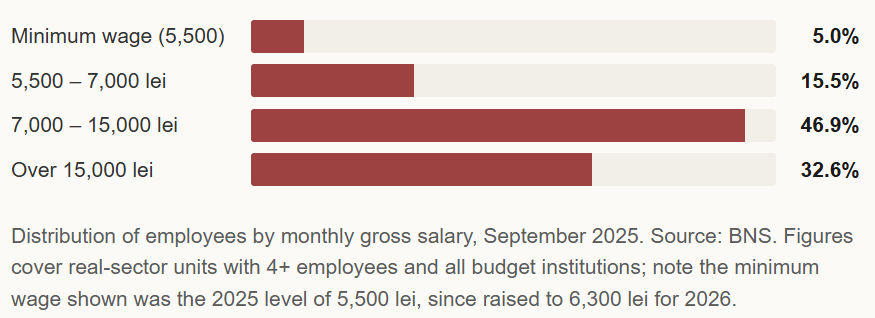
Read that table slowly, because it overturns the intuition the average creates. In late 2025, more than two-thirds of measured employees earned under 15,000 lei — that is, below the national average — and nearly half the entire workforce sat in the 7,000–15,000 band. Only about a third earned above the average line.
That is the mathematical signature of a right-skewed distribution. When a minority earns two, three, or five times the middle, the mean gets pulled toward them and away from where most people actually are. A simple illustration (invented numbers, to show the mechanism, not real Moldovan data): imagine an office of ten people. Nine earn 10,000 lei and one earns 100,000. The average salary is 19,000 lei — but nine of the ten earn barely half that, and not one person actually earns the “average.” Replace the one high earner with a Chișinău fintech lead and you have Moldova’s labor market in miniature.
The encouraging news buried in the same data is that the bottom is thinning out. The share of workers earning at or near the minimum wage has been shrinking year on year, and the over-15,000 band has been growing. The distribution is slowly shifting rightward. But the shape — a broad middle well below a mean that a wealthy minority holds aloft — is stubborn, and it is the reason “the average salary” and “what people really earn” are two different questions.
Salaries by Industry: Who Earns the Most?
The clearest way to see where the average comes from is to break it apart by sector. Here is the full BNS table for Q1 2026, ranked, with each sector shown as a percentage of the economy-wide average (100 = the national average of 15,987 lei).
| Sector | MDL/mo | vs avg |
|---|---|---|
| Information & communications (incl. IT) | 39,374 | 246% |
| Financial & insurance activities | 28,215 | 177% |
| Electricity, heat, gas & water supply (energy) | 22,645 | 142% |
| Administrative & support services | 19,138 | 120% |
| Professional, scientific & technical | 18,903 | 118% |
| Other service activities | 18,782 | 118% |
| Public administration & defense | 17,133 | 107% |
| Health & social work | 16,513 | 103% |
| National average (all sectors) | 15,987 | 100% |
| Industry (total) | 14,662 | 92% |
| Wholesale & retail trade; vehicle repair | 14,439 | 90% |
| Water/waste management | 14,085 | 88% |
| Construction | 13,940 | 87% |
| Extractive industry | 13,855 | 87% |
| Manufacturing | 13,584 | 85% |
| Transport & storage | 13,473 | 84% |
| Real estate | 13,438 | 84% |
| Education | 13,090 | 82% |
| Arts, recreation & leisure | 12,148 | 76% |
| Accommodation & food service | 11,331 | 71% |
| Agriculture, forestry & fishing | 10,246 | 64% |
The spread is the story. A worker in information and communications earns, on average, nearly four times what a worker in agriculture earns — 39,374 lei against 10,246 lei. Finance sits at 177% of the average; hospitality and farming sit at 71% and 64%. These are not marginal differences. They are the difference between a comfortable urban professional life and getting by.
Notice, too, how few sectors are actually above the average. IT, finance, energy, professional services and public administration clear the bar; almost everything that employs large numbers of people — manufacturing, retail, construction, transport, education, agriculture — sits below it. Because those below-average sectors employ the bulk of the workforce, the average ends up higher than the experience of most workers. The table is, in effect, another way of drawing the distribution from the previous section.
IT and Finance: Moldova’s High-Salary Economy
If you want to understand why Moldova’s average has climbed so fast, look at the top of that table. Two clusters — information technology and finance — do most of the lifting.
The IT story is the more dramatic. Moldova’s Innovation Technology Park (MITP), launched in 2018 with its flat 7% tax regime, has become the country’s economic showpiece. By the end of 2025 it counted around 2,725 resident companies from 44 countries employing roughly 26,000 specialists, and its aggregate turnover crossed US$1 billion for the first time — nearly ten times the 2018 level, with about 88% of that coming from exports. The park administrator has put the average salary among residents at around 50,000 lei (≈€2,500) a month, the highest in the Moldovan labor market.
Why does this sector pay multiples of the national average? The reasons compound one another: IT firms sell to international clients and are paid in hard currency; the work is high-productivity and export-oriented; skilled developers are scarce and globally mobile, so wages have to compete with what the same person could earn remotely for a Western employer; the 7% tax regime lets companies offer high net pay cheaply; and English- and Russian-language skills open Moldovan talent to a global market. Finance and insurance (28,215 lei) pay well for related reasons: banks and insurers are concentrated, capital-intensive, tightly regulated and headquartered almost entirely in Chișinău.
A necessary caveatThe 50,000-lei park average does not mean everyone in Moldovan IT earns that. It is itself an average, spanning a junior QA tester or first-year support agent at one end and a senior engineer, team lead or architect at the other. Pay in the sector rises steeply with experience, and the very top — specialists in cybersecurity, AI, fintech or blockchain leading international teams — can reach figures that are outliers even by park standards. “Working in IT” in Moldova spans an enormous range; the headline number is the ceiling’s shadow, not the floor.
Agriculture, Hospitality and Retail: Where Salaries Are Lower
At the other end sit the sectors that anchor the average down — and that, not coincidentally, employ a great many Moldovans. Agriculture (10,246 lei), accommodation and food service (11,331 lei) and the lower reaches of retail (14,439 lei on average, though much retail work pays less) form the low-wage base of the labor market.
The reasons are structural, not accidental. Agriculture is seasonal, exposed to weather and prices, dominated by small farms and low mechanization, and concentrated in rural areas where the whole local wage level is lower. Hospitality and restaurants lean on part-time and seasonal staffing, a chunk of pay arrives informally as tips that never reach a pay slip, and many businesses are small and thin-margined. Retail and personal services are similar: small units, high turnover, limited productivity per worker.
It would be a mistake to read low wages as low importance. Agriculture remains central to Moldova’s identity and exports — wine, fruit, grains — and to rural employment; the country’s gross agricultural output actually grew strongly in the first half of 2026. Hospitality and retail keep towns functioning and are often the first rung on the ladder for young workers. These sectors are underpaid relative to their social weight, which is a different thing from being unimportant.
Public Sector vs Private Sector Salaries
Moldova’s data splits the economy into a “budgetary” (public) sector and a “real” (private) sector, and the gap between them is real but easy to misread. In Q1 2026:
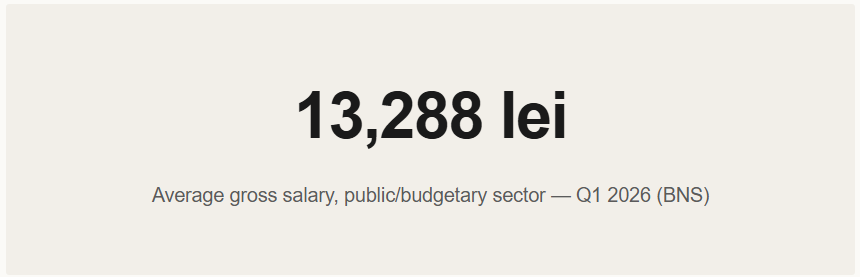
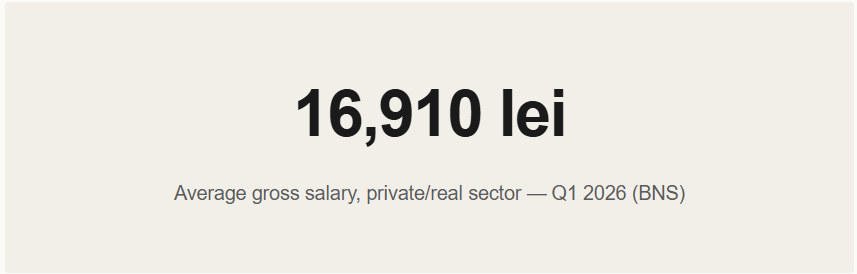
So the private sector paid about 27% more on average than the public sector. But that headline conceals two different populations. The private “real sector” contains both the 50,000-lei IT engineer and the 10,000-lei farmhand; its average is high partly because IT and finance live there. The public sector — teachers, doctors, nurses, civil servants, administrators — is more compressed, with salaries set by public pay scales rather than by an international market.
Within the public sector there is wide variation too. Public administration and defense (17,133 lei) sits above the national average, while education (13,090 lei) sits well below it — a persistent policy concern, since it is hard to attract young teachers at those levels. Healthcare (16,513 lei) lands near the average. The lesson is the same one that runs through this whole article: “public sector” and “private sector” are not single salary categories but broad containers holding very different jobs. Treating either as one number is another way of being misled by an average.
Chișinău vs the Rest of Moldova
Geography may be the sharpest fault line of all. The capital is not just the biggest labor market in Moldova; it is a different labor market. In 2024 (the latest full-year territorial breakdown), the average gross salary in Chișinău municipality was 16,955 lei — 21.2% above the national average. Every other administrative territory in the country came in below the national average. At the bottom, the district of Briceni averaged 9,433 lei, roughly a third less than the national figure, with Rîșcani close behind.
Put those two together and the spread is stark: the average Chișinău worker earned around 1.8 times the average worker in the lowest-paid districts. And because Chișinău’s average is itself dragged up by IT and finance, the very top of the Chișinău market runs far ahead of anywhere else in the country.
The reasons the capital pays more are the reasons capitals usually do. Headquarters cluster there — banks, insurers, the entire IT Park ecosystem, government ministries, the Moldovan offices of international companies, professional-services firms. Those are precisely the high-productivity, high-wage activities. A larger, denser labor market lets employers and skilled workers find each other, which itself raises pay. The result is a strong gravitational pull: talent and capital concentrate in one city, and wages follow.
The cost-of-living twistA higher Chișinău salary does not automatically mean a higher standard of living, because the capital is also where rents and prices are highest. A worker earning the national average in a small town where they own their home outright may end each month with more disposable income than a Chișinău colleague on a nominally larger salary who hands a third of it to a landlord. Salary and living standard are related, but they are not the same variable — a theme we return to below.
What Can You Earn in Moldova Without a University Degree?
Plenty of Moldova’s economy runs on work that does not require a degree, and it is a fair practical question what those jobs pay. Official statistics are organized by sector, not by occupation, so we can describe the terrain honestly using sector data while being clear about the limits: the BNS does not publish an official “average salary for a warehouse worker” or “for a driver,” and we will not invent one.
What the sector data does tell us is the band such work generally falls into. Construction averaged 13,940 lei gross in Q1 2026, transport and storage 13,473 lei, manufacturing 13,584 lei, and retail trade 14,439 lei — all somewhat below the national average, but well above the minimum wage. Hospitality (11,331 lei) and agriculture (10,246 lei) sit lower. Within each of these, an experienced or specialized worker — a skilled electrician, a long-haul driver, a crane operator — will earn more than an entry-level laborer, and in construction and the trades the best-paid manual work can approach or exceed the national average, especially where labor is scarce.
A floor is set by law: the national minimum wage rose to 6,300 lei a month in January 2026 (about €315 gross, roughly €267 net), up 15% from 5,500 lei the year before. Relatively few formally employed workers actually sit at that floor — only about 5% in the last distribution — but it anchors the bottom of the market and rises most years.
Where you see occupation-level “average salaries” on job boards or aggregator sites, treat them with care: they are compiled from adverts or user submissions, not from measured payroll data, and they can differ substantially from what people are actually paid.
What Can Professionals Earn in Moldova?
For higher-skilled work, the honest answer is again a range rather than a point, and the reliable anchors are sectoral. A professional’s pay in Moldova depends enormously on which profession and, within it, on seniority.
At the top, software developers and other IT specialists inside the Park average around 50,000 lei, with juniors well below that and senior engineers and leads well above. Finance and insurance professionals — bankers, analysts, actuaries, auditors — sit in a sector averaging 28,215 lei, again with a wide junior-to-senior spread. Professional, scientific and technical roles (a category that captures many engineers, accountants, lawyers, consultants and architects) averaged 18,903 lei in Q1 2026, about a fifth above the national average. Doctors fall within healthcare (16,513 lei on average), though specialists and those in private practice can earn considerably more than the sector mean, while junior public-hospital staff earn less.
Across all of these, the same structure holds: entry-level pay clusters below the sector average, mid-career pay lands around it, and senior pay — management, specialization, scarce expertise, international clients — runs well above. Job-board figures for specific titles can sketch these bands, but they are advertisements and self-reports, not official wage statistics, and should be read as indicative rather than authoritative.
Are Salaries in Moldova Rising?
Yes — and this is where the distinction between nominal and real becomes essential. In Q1 2026, the average gross salary rose 9.7% year on year in nominal terms. That sounds dramatic. But prices were rising at the same time, and once you divide the wage index by the consumer price index, the real increase was 4.3%. Workers were genuinely better off — but by less than half of what the headline percentage suggested.
This gap is the whole point. A 10% pay rise in a year of 6% inflation is a 4% improvement in what your money buys; the same 10% rise in a year of 12% inflation is actually a cut in real terms, even though the number on the pay slip went up. Moldova has lived both experiences recently: after the severe inflation shock of 2022–2023, real wage growth briefly turned negative or flat, then recovered as inflation cooled. Over 2025 as a whole, nominal wages grew 9.8% but real wages grew just 1.9%, because inflation ate most of the gain.
The one habit worth keepingWhenever you see “salaries rose by X%,” ask what inflation was that year. The real figure — nominal growth minus inflation — is the only one that tells you whether people can actually buy more. In Moldova, the real number has usually been positive in recent years, but far smaller than the nominal one.
Are Moldovan Salaries High or Low by European Standards?
Low — but the comparison needs care, because it is easy to compare the wrong things. Moldova’s average gross salary of about €800 a month sits below every EU member state. For a fair sense of scale, compare gross-to-gross with its nearest neighbors and peers.
| Country | Gross/mo (≈EUR) |
|---|---|
| Moldova | €800 |
| Bulgaria | €1,475 |
| Romania | ≈€1,400 |
| Poland | ≈€1,500+ |
| EU average | ≈€3,300 |
Two honest caveats keep this from being misleading. First, compare like with like. All the figures above are gross. It would be wrong to set Moldova’s gross salary against another country’s net take-home — and tempting, because Moldova’s low employee tax burden (roughly 21% for a standard worker, versus far higher wedges in much of the EU) means its net figures hold up somewhat better than its gross ones. Second, exchange rates are not living standards. Converting lei to euros tells you nothing about what those lei buy at home. Once you adjust for local prices (purchasing power), the gap between Moldova and its neighbors narrows considerably, because rent, food and services cost far less in Chișinău than in Warsaw or Bucharest. Moldova is a low-wage country in nominal terms; in purchasing-power terms it is poorer than its EU neighbors but by a smaller margin than the euro figures imply.
What Does a Salary of 10,000 MDL Mean in Moldova?
Numbers become meaningful only when attached to a life. Here is what a range of net monthly incomes realistically translates to, for a single person in Chișinău, using current cost-of-living data (rent for a one-bedroom flat runs roughly €300–€500 in the center, less outside it; groceries, utilities and transport for one person add a few hundred euros more). These are relative descriptions of financial comfort, not guarantees of a particular lifestyle.
| Net/mo (MDL) | What it broadly means for one person in the capital |
|---|---|
| ~7,000 | Tight. Covers basics if rent is low or shared; little room for savings or the unexpected. Common in lower-paid sectors and outside the capital. |
| ~10,000 | Manageable but careful. Rent, food and transport are covered; discretionary spending and saving are limited. |
| ~15,000 | Reasonably comfortable for a single person: market rent, a decent standard of living, some saving possible. |
| ~20,000 | Comfortable. Room for rent, leisure, travel and steady saving. Above what most single workers earn. |
| ~30,000 | Well-off by local standards. Typical of experienced IT/finance professionals; substantial disposable income. |
| 40,000+ | High income. A small minority — senior specialists, managers, top IT roles. Financial ease uncommon in the wider population. |
The single biggest swing factor missing from that table is housing. Every line assumes market rent. Remove it — because the person owns their home or lives with family, as many Moldovans do — and each row jumps a category in real comfort. Which brings us to the central practical question.
Can You Live Comfortably on the Average Salary?
It depends almost entirely on two things the salary figure never tells you: how many people that income supports, and whether it pays rent.
A single person earning the average net salary (≈13,000 lei) can live modestly-to-comfortably in Chișinău, more easily if they own their home, more tightly if they pay central rent. Outside the capital, where both wages and costs are lower, the same nominal salary stretches differently — lower rent, but often a lower salary to begin with.
A couple with two average salaries is a completely different proposition. Two incomes of ≈13,000 lei net is ≈26,000 lei entering one household — but the household’s costs (rent, utilities, some food) do not double. Two average earners sharing one flat are comfortable by Moldovan standards. This is why the leap from “one average salary” to “two average salaries” matters more than any single wage statistic: household composition, not the individual number, often decides living standards.
A family with children reintroduces strain: childcare, larger housing, more food, and often one parent working reduced hours. A family relying on a single average salary in the capital will feel stretched; two salaries plus support from grandparents (a common Moldovan arrangement) or from relatives working abroad changes the picture considerably.
The recurring variable is home ownership. A household on a modest salary but with no rent to pay can be more financially secure than a higher-earning household handing 30–40% of income to a landlord. The salary alone cannot tell you which is which.
Why “Average Salary” Does Not Tell the Whole Story
By now the argument has a clear shape. A salary figure is only the starting point of understanding someone’s economic life. To know what an income actually means, you have to know:
- Household size — how many people the income supports.
- Housing costs — renter or owner, capital or small town.
- Location — Chișinău wages and Chișinău prices, or lower on both counts elsewhere.
- Employment stability and benefits — a steady formal job versus seasonal or informal work.
- Taxes — standard payroll or the IT Park’s 7% regime.
- Informal income and remittances — money that never appears in official wage data.
One Moldovan household may report a modest salary but own its home and receive regular help from a family member abroad, and live comfortably. Another may have two respectable salaries but pay high central rent, and feel squeezed. The wage statistic, on its own, cannot distinguish them — which is exactly why “the average salary” is the beginning of the analysis, not the end.
The Role of Informal Work and Remittances
No account of Moldovan incomes is complete without the money that official salary statistics do not capture. Two channels matter enormously.
Informal and self-employment. A meaningful share of economic activity happens outside the formal, four-plus-employee firms the BNS survey measures — micro-businesses, self-employed tradespeople, family farms, casual and cash work, side income. We should be careful here: precisely because this activity is informal, there is no reliable figure for what such workers “typically” earn, and it would be wrong to assert one. The point is structural — official wage data describes the formal economy, and a real part of Moldovan household income sits outside it.
Remittances. Moldova has one of the largest diasporas relative to its population of any country in Europe, and the money those workers send home is a pillar of the economy. Personal remittances have run at roughly 10–12% of GDP in recent years (down from peaks nearer 15% and higher in the 2000s), according to World Bank and IMF data, with quarterly inflows tracked by the National Bank of Moldova. For a great many families — especially in rural areas and among older residents — a transfer from a son in Italy or a daughter in Germany is not a top-up but a central part of the monthly budget. It pays for housing, education, healthcare and daily costs, and it does not appear anywhere in the average-salary figure.
Together, informal income and remittances mean that measured salaries understate total household resources for a significant part of the population — another reason the wage average, taken alone, is an incomplete portrait of how Moldovans actually live.
What Salary Do You Need to Live in Chișinău?
Here is a practical framework for the capital, built from current cost-of-living data. These are analytical categories to help judgment, not official poverty lines or government thresholds — and they assume market rent, which as we have seen is the biggest single variable.
| Lifestyle | Single (net/mo) | Couple | Family (2+1) |
|---|---|---|---|
| Basic survival | ~8,000 | ~13,000 | ~18,000 |
| Modest, stable | ~12,000 | ~20,000 | ~28,000 |
| Comfortable | ~18,000 | ~30,000 | ~42,000 |
| Higher-income | 30,000+ | 50,000+ | 65,000+ |
The table shows why the capital’s labor market feels the way it does. A single person on the average net salary (≈13,000 lei) lands between “modest” and “comfortable” — workable, not luxurious. A couple pooling two average salaries reaches “comfortable” without difficulty. A family on a single average salary hovers around “modest, stable” and feels every unexpected expense. And in every row, owning rather than renting shifts the household up a band.
Is Moldova Still a Low-Salary Country?
The honest answer is: yes, but less simply than that phrase suggests.
The case that it remains low-wage. Moldova’s average salary is below every EU member state’s; a large majority of workers earn under the national average; many sectors — agriculture, hospitality, much of manufacturing — run on low productivity and low pay; and the income gap between the capital and the countryside, and between IT and everything else, is wide and persistent.
The case that the label is dated. Wages have been rising in real terms in most recent years; the bottom of the distribution is thinning as the minimum wage climbs; some sectors — IT above all, but also finance and professional services — are genuinely internationally competitive and pay well by any regional standard; Chișinău’s labor market is a different animal from rural Moldova; and because local prices are low, purchasing power holds up better than the euro-converted headline implies.
Both are true at once. Moldova is a low-wage country that contains a high-wage economy inside it, concentrated in one city and a few sectors, growing faster than the rest. “Low-salary country” is accurate as a summary and misleading as a description of any individual worker — which is the same lesson the average taught us, restated at national scale.
What the Salary Numbers Tell Us About Moldova’s Economy
Step back, and the wage data becomes a kind of X-ray of the economy’s structure. The four-to-one gap between IT and agriculture is a productivity gap: it shows an economy with a small, modern, export-facing, internationally-priced sector sitting atop a much larger base of traditional, domestically-priced, lower-productivity work. The 21% Chișinău premium is a map of where capital, skills and headquarters have concentrated — and, implicitly, of the internal migration pulling young workers toward the capital and out of the districts.
The prominence of remittances reveals a labor market that has, for a generation, exported people as well as goods, so that a chunk of the nation’s income is earned abroad and sent home. The rising minimum wage and shrinking low-wage share reflect deliberate policy and a tightening labor market, as emigration and demographic decline make workers scarcer and give those who remain more bargaining power. And the fast growth of the IT Park hints at the direction of travel: an economy trying to move up the value chain, tied increasingly to European integration and global services.
Salaries, in other words, are not just a scoreboard of how rich a country is. They are a window into how its economy is built — where the productivity lives, where the people go, and which way the whole system is tilting.
Myths vs Reality
Myth “The average salary is what most Moldovans earn.”
Reality More than two-thirds of measured employees earn below the average. A minority of high earners in IT, finance and energy pulls the mean above where most workers actually sit.
Myth “Everyone in Moldovan IT earns a huge salary.”
Reality The ~50,000-lei IT Park figure is itself an average spanning junior support staff to senior architects. Pay rises steeply with seniority; juniors earn a fraction of the top.
Myth “Chișinău and rural Moldova have similar salaries.”
Reality Chișinău averaged 21% above the national figure in 2024, while the lowest districts sat roughly a third below it — a gap of nearly 1.8 to 1 between capital and countryside.
Myth “A pay rise automatically means people are better off.”
Reality Only real (inflation-adjusted) growth counts. In Q1 2026, a 9.7% nominal rise was a 4.3% real one; in a high-inflation year, a nominal rise can even be a real cut.
Myth “Gross salary is the amount you receive.”
Reality Employees pay 9% health insurance and 12% income tax (after a personal deduction), taking home roughly 80–85% of gross. The ~16,000-lei average becomes ~13,000 lei in hand.
What Salary Is Considered Good in Moldova?
Combining the distribution with the cost of living, here is a practical framework for reading a Moldovan salary. These are analytical bands based on where earnings actually fall and what they buy — not official classifications.
| Band | Gross/mo (MDL) | Rough position |
|---|---|---|
| Low income | up to ~7,000 | At or near the minimum wage; the bottom fifth of earners. |
| Below average | ~7,000–12,000 | The broad lower-middle; common in agriculture, hospitality, junior roles. |
| Around average | ~12,000–18,000 | The national middle; much of retail, manufacturing, public sector, mid-career staff. |
| Comfortable professional | ~18,000–30,000 | Skilled professionals, finance, experienced specialists; clearly above the average. |
| High income | 30,000+ | Senior IT and finance, management, scarce expertise; a small minority. |
By these lights, a salary is “good” in Moldova once it clears roughly the 18,000-lei gross line — above the national average, into comfortable professional territory — and genuinely high above 30,000. But context bends every line: 15,000 lei with no rent to pay outperforms 22,000 lei that funds a central mortgage, and a good salary in Briceni is a modest one in the capital.
What Foreigners Should Know About Moldovan Salaries
For an international reader weighing a move to Moldova, the labor market splits into two very different experiences.
If you earn a local salary, you are inside everything described above: a national average around €800 gross, a low tax burden that preserves most of it, a comfortable-if-modest life on an average income in the capital, and a real ceiling on pay outside a few sectors. Local employment rewards specific skills — IT, finance, languages, engineering — and is thinner for generalists. Russian remains useful, especially with older residents, though Romanian is the state language and English is common among younger professionals.
If you earn a foreign salary and live in Moldova, your experience inverts. A remote worker or entrepreneur paid Western rates while spending Moldovan prices enjoys some of the strongest real purchasing power in Europe: Chișinău is among the continent’s most affordable capitals, rent and food cost a fraction of Western levels, and a US or EU income goes remarkably far. This is the arbitrage that makes Moldova attractive to remote workers — the same low local wages that constrain residents become an advantage for those whose income is set elsewhere.
The practical implication: the same city can feel expensive or absurdly cheap depending on which side of the wage gap your paycheck comes from. A foreigner earning €800 locally and a foreigner earning €4,000 remotely live in two different Moldovas.
The Future of Salaries in Moldova
Predicting exact figures a decade out is a fool’s errand, but the forces acting on Moldovan wages are visible enough to sketch the direction.
Pushing wages up: the country’s EU-accession path, which brings investment, regulatory alignment and market access; a tightening labor supply, as emigration and an aging population make workers scarcer and strengthen their bargaining hand; the continued expansion of the IT and services economy; foreign investment and nearshoring, as companies look east of the EU core for cost-effective talent; and steady minimum-wage increases.
Pulling the other way, or complicating the picture: low productivity in large traditional sectors, which caps how fast their wages can rise; the risk of continued brain drain if the best-paid talent keeps leaving; automation, which could hollow out some mid-skill work; demographic decline, which shrinks the workforce and the domestic market; and gaps in education and infrastructure that constrain the move up the value chain.
The likeliest path is not a single trend but a widening of the ones already visible: the modern, export-facing economy and the capital continuing to pull ahead, the traditional and rural economy rising more slowly, and policy, migration and European integration deciding how fast the gap between them closes — or doesn’t.
Conclusion: There Is No Single Moldovan Salary
Return, finally, to the question we started with: what do people in Moldova really earn? The truthful answer is that there is no single number, and the search for one is what leads people astray. There is the €800 average that makes headlines, the ≈13,000-lei net that an average earner actually banks, the 50,000-lei IT engineer and the 10,000-lei farmhand, the 21% Chișinău premium and the rural discount, the salaried worker and the family living partly on money wired from abroad.
What people earn in Moldova is a spectrum, shaped by industry, location, skill, age, experience, employment type and household structure — and read correctly, that spectrum tells you more about the country than any average could. The single figure describes a Moldova that does not quite exist: a nation of people all earning 16,000 lei. The distribution describes the real one: a broad working middle earning well below the mean, a modern high-wage economy concentrated in one city and a few sectors pulling the average up, a large diaspora quietly topping up household budgets, and a labor market slowly, unevenly, tilting toward Europe. The average is a headline. The distribution is the story.
Sources & reference periods
- National Bureau of Statistics of Moldova (BNS), “Average gross monthly earnings, Q1 2026” — national average 15,987.1 lei; sectoral table; public 13,288 / private 16,910; real growth 4.3%. Published 2 June 2026. statistica.gov.md
- BNS, “Distribution of employees by size of salary, September 2025” — salary-band shares (5.0% / 15.5% / 46.9% / 32.6%).
- BNS, annual earnings and territorial data 2024 — Chișinău 16,955 lei (+21.2%); Briceni 9,433 lei; 2025 annual average 15,472 lei.
- Government of Moldova / Ministry of Labour — minimum wage 6,300 lei and reference average 17,400 lei (social-insurance forecast) from 1 January 2026.
- Moldova Innovation Technology Park (MITP) / Moldpres / EU4Digital — 2025 turnover >US$1bn, ~26,000 employees, ~50,000-lei average, 7% single tax.
- Moldovan Tax Code / official 2026 payroll rules — 12% flat income tax, 9% CNAM (employee), 24% CNAS (private-sector employer), 2,475-lei monthly personal deduction. Net examples are the author’s illustrative calculations.
- National Bank of Moldova; World Bank; IMF — remittances (~10–12% of GDP recently).
- Eurostat / Euronews / national statistical agencies — European salary comparisons (2025–2026).
- Cost-of-living data: Numbeo, Wise, expat sources (Chișinău, 2026). Exchange rate ≈ 1 EUR / 20 MDL (August 2026).
Salary figures reflect the latest official data available at the time of writing (Q1 2026 for the headline average). Because Moldovan wage statistics are updated quarterly, the numerical figures should be refreshed periodically against BNS releases, while the explanatory analysis remains applicable.